
HOLY SHIT, I FOUND IT!!!
What began as household Mythology has now become Archaeological Fact.

For months, the stash existed somewhere between behavioural hypothesis, running joke, and household mythology.
I suspected it was real.
I also increasingly suspected I might be losing my mind.
Socks vanished for weeks before reappearing dust-heavy and compressed. Previously documented specimens disappeared, then returned again later. The numbers never fully added up. Theories formed. Patterns emerged. No physical evidence was ever located.
Multiple calculated searches failed.
Eventually, I stopped actively looking for it.
Then, on the 8th of May (yes its taken me almost a whole week to compose this report ), while loading the washing machine, I accidentally discovered the entrance to what can only be described as Bramble’s hidden underground sock archive beneath the kitchen cupboards.
Reader, the stash was real.
Not “a couple of socks under furniture” real.
Real real.
Hidden.
Curated.
Eighteen socks real.
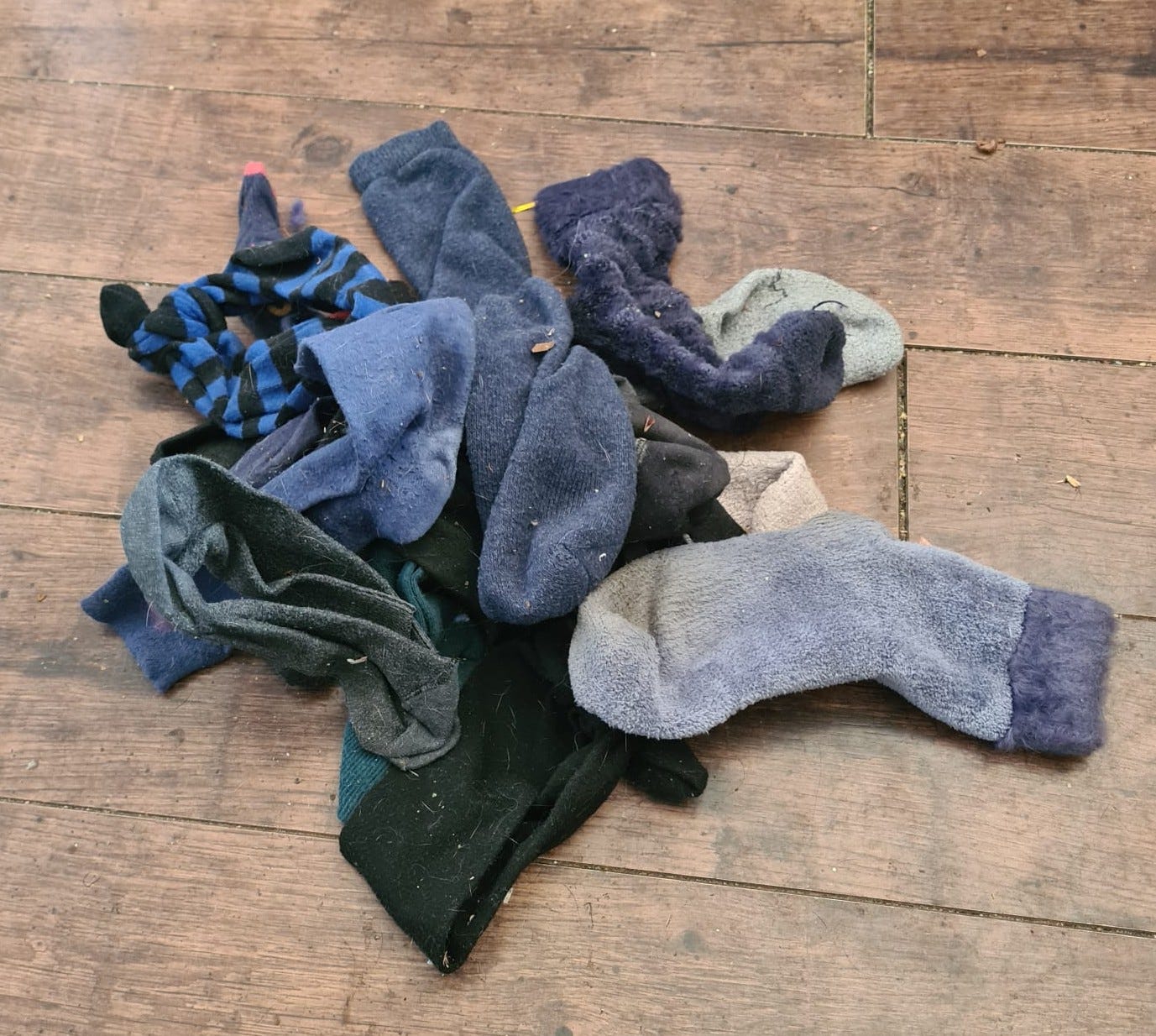
RECOVERY EVENT 01
Discovery of the Primary Cache Site
I. Historical Background
For a considerable period within the ongoing Sock Files investigation, the existence of a hidden stash site remained theoretical.
Dust-heavy repeat specimens, unexplained disappearances, delayed returns, and the persistent mismatch between known acquisitions and recovered overnight offering specimens repeatedly suggested the existence of retained hidden storage operating somewhere within the domestic environment.
However, retrospective analysis now suggests that overnight offering behaviour predates the formal Sock Files investigation by a considerable margin.
Long before daily documentation began, isolated incidents occasionally occurred during overnight visits from Molly, in which freshly worn Molly socks disappeared overnight before subsequently appearing in the observer’s bed by morning. At the time, these incidents were interpreted simply as opportunistic theft behaviour associated with a high-value social individual and a sock-obsessed spaniel.
The events were too infrequent and irregular to trigger formal investigation. Molly eventually began guarding her socks more carefully in order to locate them quickly enough for work the following morning.
Over time, however, the behaviour intensified, stabilised, and became increasingly ritualised. Overnight offering events became more frequent, pillow placement behaviour became more precise, and recurring patterns gradually became impossible to ignore.
Recent weeks had also seen a marked alteration in behavioural activity. Sock acquisition behaviour itself had not ceased. The subject continued to utilise socks for apparent emotional regulation purposes, continued celebratory sock transport throughout the home, and on isolated occasions still delivered individual offerings directly to the observer during periods of visible distress or dysregulation.
What changed was the overnight offering ritual itself.
For over two weeks, no dawn pillow placements occurred.
At the time, several possible contributing factors were considered. The subject had entered heat. A clandestine and strictly prohibited mating event had occurred. Household routines had altered substantially. Doughnut had temporarily vacated the premises. Whether the mating event was successful remains unknown pending further observation over the coming weeks.
Complicating interpretation further was a broader restructuring of the household social environment during the same period.
Doughnut’s removal during hump week was necessary to avoid further risk of irresponsible pregnancy & because his behaviour around Bramble had become intensely stressful for both dogs and the observer. Bramble’s corrections can appear dramatic and severe, though they are usually inhibited and rarely result in any injury. However, if Doughnut fails to back off quickly enough, escalation can occur. The temporary separation was therefore a management intervention during a highly charged hormonal period.
Historically, Doughnut would usually stay with his father figure during this period. Since that arrangement is no longer part of the dogs’ regular life, an alternative had to be found. When the new expected arrangement collapsed at the very last minute, Oli stepped in extremely quickly, reorganising his mother’s household to accommodate Doughnut during an already highly stressful period for everybody involved.
Doughnut went to Oli’s house with food, toys, a blanket from the observer’s bed, and familiar scent items. He was staying somewhere unfamiliar, with unfamiliar people and an unfamiliar cat. Oli was the only familiar anchor in that environment.
Both dogs had been becoming increasingly bonded to Oli over recent months.
Bramble’s attachment expressed itself primarily through escalating affection-seeking behaviour, increased proximity preference, and increasingly Molly-like patterns of social attention. She frequently chose to orient toward Oli when he was present, often sitting beside him instead of the observer and directing increasing amounts of affiliative behaviour toward him.
Doughnut’s attachment developed differently. His greeting behaviour toward Oli became progressively more intense over time, eventually extending to waiting at the door and soft distress vocalisations during short temporary absences. During hump week, this attachment intensified substantially. While staying with Oli, Doughnut reportedly remained unusually settled compared to previous separation periods and appeared primarily concerned only when separated from Oli himself.
Following hump week, Doughnut began accompanying Oli during bathroom routines and increasingly displaced Bramble from previously established Oli-related affiliative rituals. Notably, Bramble appeared entirely comfortable with this redistribution of social access, continuing to remain nearby while allowing Doughnut to assume the more direct interaction role.
Hayden’s role is also important.
Hayden has lived in the household since August, and the dogs have been bonding with him steadily over the months since then. Alongside Oli, he appears to have become one of the primary male attachment figures in the dogs’ current social world. Both Hayden and Oli appear to have gradually filled part of the social space left by the dogs’ original Father figure’s absence.
Hayden’s routine also changed during the same period. After leaving his previous job, he had a short period where he was home far more than usual. Then, partway through the second problematic week of Bramble’s heat cycle, he left for a full week with his new job and was not due to return until the 13th of May.
Taken together, the period preceding recovery was characterised by substantial hormonal, social, environmental, and attachment-system instability across the household ecosystem.
And despite all of this, the subject continued to commit organised textile crime whenever opportunity allowed.
II. Recovery Event
The primary cache site was discovered on the 8th of May.
While loading the washing machine, the observer noticed a single sock edge protruding from beneath the kitchen cupboards beside the washing machine through a gap where skirting board infrastructure should, ideally, have existed.
Initial retrieval efforts immediately revealed that the visible specimen was not alone.
Despite significant reluctance to engage in floor-level investigative activity due to chronic back pain, the observer abandoned all sensible back-protection protocols, lowered to ground level, and conducted a direct visual inspection beneath the cupboard units.
This decision was rewarded with the opportunity to excavate a grand total of eighteen socks from the hidden cache site beneath the kitchen cupboards.
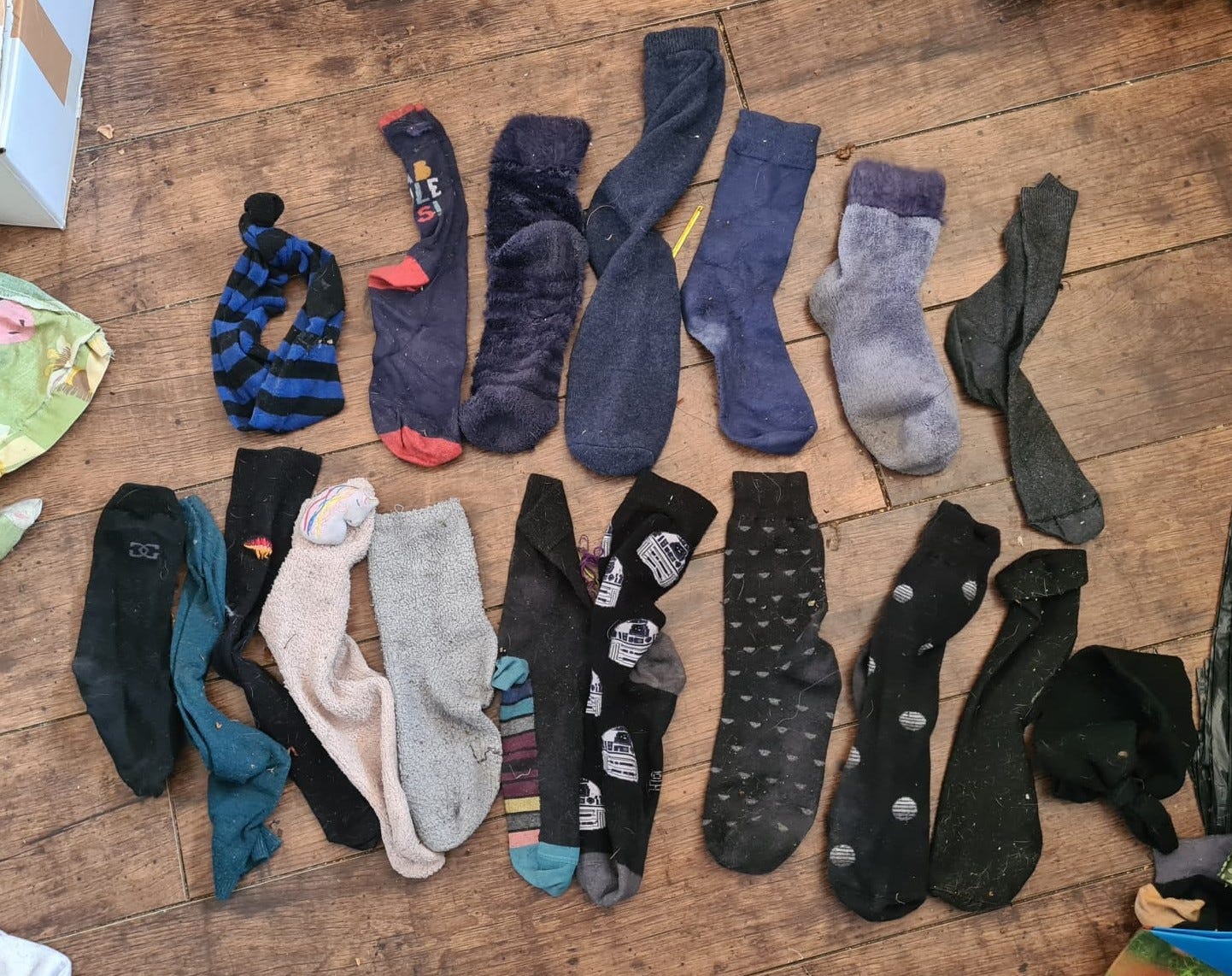
Recovered specimen distribution was as follows:
Eight Hayden specimens
Seven observer specimens
Two Oli specimens
One Molly specimen
Many recovered specimens appeared familiar from previous documented Sock Files entries, suggesting that at least part of the recovered material had previously participated in observed overnight offering events prior to re-entering hidden storage.
Approximately half of all recovered specimens are believed to have appeared in previous documented Sock Files investigations.
Six recovered specimens were clearly blue in colour, with an additional two containing substantial blue visual elements. Given that black socks overwhelmingly dominate the broader household sock ecosystem, the colour distribution immediately stood out.
Given the subject’s longstanding and well-documented preference for blue tennis balls, the recovery may provide further evidence supporting selective visual targeting behaviour associated with canine dichromatic colour perception.
The brightest blue specimen previously documented within the investigation was associated with unusually intense acquisition behaviour during one of the now infamous Fort Sox breach events, involving successful extraction from Hayden’s restricted-access sock zone.
The single Molly specimen possessed a small plush unicorn attachment, making it objectively ridiculous and almost certainly behaviourally significant.
Two recovered over-the-knee observer specimens had additionally been tied into looped formations. While likely behaviourally insignificant beyond novelty and altered texture profile, the formations remain formally documented here for completeness.
Importantly, the recovered specimen distribution may suggest multiple overlapping acquisition drivers operating simultaneously:
scent-based relational value
colour salience
novelty
texture
accessibility
scarcity
and current household attachment dynamics


Photographic evidence of the recovery zone was obtained post-excavation. These images show the under-cupboard cavity after specimen removal, including the exposed gap beneath the missing skirting board beside the washing machine.
The surrounding debris field consisted primarily of dust, cobwebs, grit, unidentified kitchen sediment, and shame.
This detail is significant because previous investigation notes repeatedly hypothesised that any genuine stash site would likely exist in an area sufficiently hidden from humans that it escaped not only detection, but routine environmental maintenance altogether.
Unfortunately, this hypothesis proved entirely correct.
At this point, the investigation entered full pharaoh’s tomb territory.
There are moments in life where a person must accept that they have excavated eighteen selectively curated socks from a filthy hidden sub-kitchen vault while army crawling on the floor with a painful spine beside a washing machine.
This was one of those moments.
III. Subject Response During Excavation
Notably, the subject was present for portions of the excavation and documentation process.
Bramble approached the recovered specimens and investigated the scene, but did not display overt distress, defensive behaviour, frantic recovery attempts, or obvious possessive responses during or following exposure of the cache site.
She did not appear outraged.
She did not lodge a formal complaint.
Instead, behaviour appeared observational, socially engaged, and comparatively calm.


This does not imply that concealment lacked behavioural significance.
On the contrary, the longevity and effectiveness of the cache site strongly suggests that concealment was central to the behaviour. The site remained hidden for an extended period despite repeated suspicion that a stash existed somewhere within the house.
The behaviour appears to have been conducted covertly, in the absence of human observation. If the under-cupboard cavity were merely a default sock location, the observer would likely have seen deposition behaviour before now.
That interpretation is strengthened by the nature of the cache. It was not a random build-up of household debris. It was not a general under-cupboard pile. It was a curated sock deposit, hidden in a filthy, inaccessible space where human hands rarely, if ever, reached.
One possible interpretation is that high-value specimens were temporarily removed from human circulation while scent value remained strong, then quietly reintroduced later once that value diminished.
If correct, the cache may have functioned less as permanent storage and more as part of an ongoing scent-management and delayed-circulation system.
Which is a completely absurd sentence to have written about socks, and yet here we are.
IV. Retrospective Implications
The recovery of the primary cache site materially alters interpretation of multiple earlier investigative anomalies.
Prior to recovery, repeated inconsistencies had emerged between directly observed sock acquisition events and the total number of specimens subsequently documented through overnight offering behaviour. Individual socks frequently vanished for extended periods before reappearing heavily dusted, compressed, or carrying particulate contamination inconsistent with normal domestic circulation patterns.
At the time, these events were interpreted as possible evidence of retained hidden storage behaviour.
The recovery event strongly supports that interpretation.
Importantly, the recovered specimens do not appear consistent with accidental environmental accumulation. While small household items have occasionally been retrieved from beneath the kitchen cupboards over the years, the recovery zone at the time of excavation contained no meaningful mixed household object collection beyond general dirt accumulation and the sock stash itself.
The specimens were densely compacted beneath the cupboard units in a manner consistent with repeated targeted deposition over time.
However, the recovery event also suggests that the cache site functioned as more than passive storage.
A substantial proportion of recovered specimens appeared to have previously participated in documented overnight offering events earlier in the investigation timeline before subsequently disappearing again.
This may suggest that cached specimens were not necessarily permanently retained following overnight offering behaviour, but instead circulated repeatedly between acquisition, storage, and re-offering phases over extended periods.
The cache site therefore appears not merely to have functioned as hidden storage, but as part of an active ongoing behavioural system.
Possibly archive.
Possibly vault.
Possibly the domestic equivalent of a dragon’s hoard, if the dragon were black, small, and obsessed with scented textiles.
The recovered distribution pattern may additionally suggest selective acquisition preferences rather than random opportunistic theft behaviour.
The low number of Oli specimens within the cache may initially appear inconsistent with the increasingly Oli-specific nature of recent overnight offering events. However, this may instead reflect scarcity-based value dynamics. Oli socks exist in comparatively lower environmental density within the household ecosystem while potentially possessing disproportionately high relational scent value.
Similarly, the presence of only one Molly specimen should not necessarily be interpreted as low relational value. Molly socks are relatively scarce within the household, but historically high value. The recovered Molly sock also carried additional novelty and tactile features due to its plush unicorn attachment.
Hayden and observer specimens dominate the cache numerically. This may reflect greater availability and higher environmental density rather than lower selectivity. Hayden and the observer represent the densest accessible sock sources in the household, while Oli and Molly specimens may be rarer but have more novelty based relationally value.
Hayden’s dominance within the recovered specimen count may also be relevant in light of his recent absence from the household following a period of unusually high proximity. It is not possible to determine whether this reflects simple availability, increased scent-value relevance, or some combination of both.
The existence of retained hidden storage explains where at least some missing specimens were located. It does not explain why specific socks were selected, why certain specimens were formally offered while others remained cached, why overnight offering behaviour fluctuated dramatically over time, or why recent events appear increasingly associated with Oli-specific acquisition patterns.
Similarly unresolved is the apparent connection between sock acquisition behaviour and overnight offering behaviour.
While formal dawn pillow placements had largely ceased for over two weeks prior to recovery, the subject continued to transport socks throughout the home, utilise socks during apparent emotional regulation periods, and engage in isolated targeted offering events toward the observer during periods of distress.
V. Post-Recovery Behavioural Continuation
At the time of initial cache recovery, the marked reduction in overnight offering behaviour had raised the possibility that the long-running ritual may have been entering a dormant or transitional phase.
Subsequent events complicated this interpretation considerably.
On the 11th of May, one further overnight offering event occurred.
Importantly, the returning pattern did not fully resemble earlier acquisition periods. Instead, the event appears strongly concentrated around highly specific social and environmental conditions, most notably the overnight presence of Oli and the availability of freshly worn Oli-associated specimens.
After the discovery, two separate Oli socks worn the previous day were delivered during the same night cycle. The observer initially awoke during the early hours to find a single specimen positioned beside the pillow. Several hours later, a second specimen appeared following what is suspected to have been an additional acquisition and return operation conducted after the observer had resumed sleeping.
The current pattern may suggest increasing social selectivity, increased value associated with highly recent scent profiles, or a growing behavioural association between the subject and specific individuals under particular environmental conditions.
However, this should not be interpreted as Bramble suddenly becoming attached to Oli. Bramble was already highly attached to Oli.
The larger relational shift appears to have occurred in Doughnut.
Following the hump week separation period, Doughnut increasingly began:-
greeting Oli at the door
displaying anticipatory waiting behaviour during short absences
softly whimpering when Oli went to the shops
accompanying Oli during bathroom routines
and partially displacing Bramble from previously established Oli-related affiliative rituals
Bramble does not appear to have responded to these shifts with elevated jealousy or resource-guarding behaviour. Instead, the dogs appear to have redistributed aspects of social access and affiliative interaction fluidly within the evolving household social structure.
Bramble’s affection toward Oli remains intense and established. Doughnut’s attachment to Oli appears to have deepened substantially during the same period in which Bramble’s heat cycle, Doughnut’s temporary relocation, and changes in overnight offering behaviour were all occurring.
Hayden’s role must also remain part of this interpretation.
Hayden has been living in the household since August last year and has become increasingly important to both dogs over that period. His recent routine changes created an additional disruption. He was home unusually often between jobs, then absent for a full week during a period when the dogs were already navigating hormonal, social, and household instability.
For dogs built around routine, scent, and relational access, these are not minor disruptions.
Taken together, recent events may indicate not behavioural cessation, but behavioural reorganisation within a changing attachment ecosystem.
The observer additionally notes uncertainty regarding the possible impact of removing the stash itself from the environment following excavation.
All recovered specimens were photographed, documented, and immediately washed. Retrospectively, questions remain regarding how the subject may interpret:-
discovery of the site
removal of the stored specimens
loss of accumulated scent and environmental context associated with the cache
and the sudden compromise of a previously successful covert storage location
Whether the subject will:-
establish a secondary cache site
attempt reconstruction within the original location
abandon long-term storage behaviour entirely
or escalate operations following compromise of the primary cache site
remains unknown.
Given the subject’s intelligence, adaptability, and apparent awareness that the original cache has been found, the establishment of a new covert cache site may be more likely than simple reconstruction in the compromised location.
This possibility is behaviourally plausible and deeply inconvenient.
At present, the investigation cannot determine whether the observed changes represent:-
temporary hormonal disruption
social restructuring associated with changing household dynamics
increasing behavioural fixation on particular individuals
altered scent-value hierarchies
cache displacement effects following site compromise
loss or redistribution of hidden scent objects
or a broader long-term transition in the overnight offering system itself
The stash was real.
Its discovery confirmed one of the central long-running theories of the Sock Files investigation while simultaneously failing to explain almost everything else.
Further monitoring is required.
Really really funny. Love.
I was ecstatic (and very proud) to firsthand witness discovery of the long-hypothesised cache 💜💜💜