

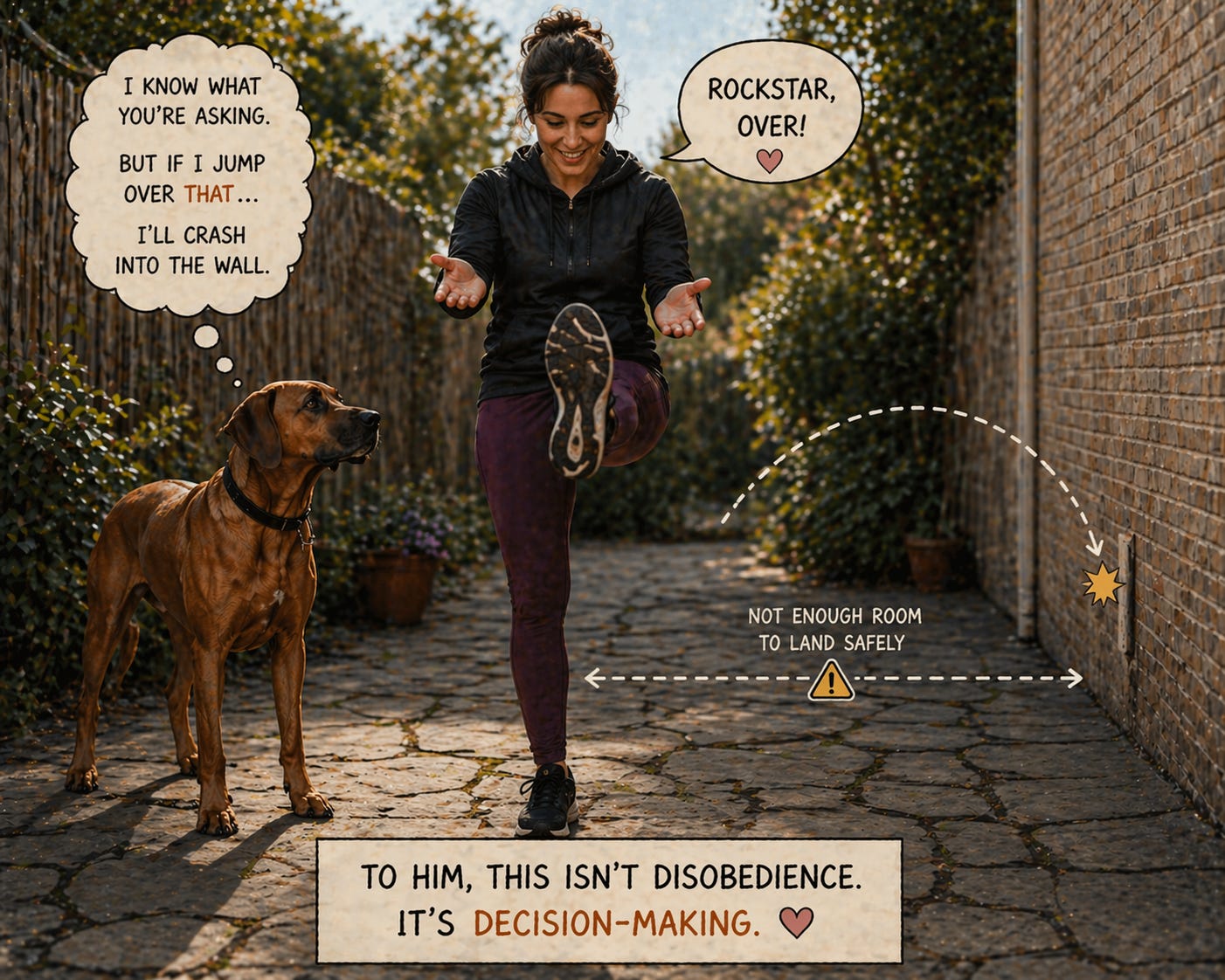
We often talk about what dogs do.
Recall, reactivity, training, behaviour.
But underneath all of that is something quieter, and far more important: how dogs make decisions.
Dogs are not simply moving through the world at random. They are constantly choosing within it, deciding where to go, who to approach, what matters, and what does not.
And when you start to look closely, a clear pattern begins to emerge.
Dogs are working through the world using a form of logic shaped by evolution, tuned by experience, and grounded in what is immediately relevant to them.
Decisions are not obedience
It is easy to think of behaviour as something a human either has control over or does not.
A dog either listens, or does not. A dog either obeys, or ignores.
But when a dog does not come back when called, they have not forgotten. They have made a decision.
In that moment, something else carries more weight. A scent, movement, distance, or simple curiosity may outweigh the value of returning. Recall is one option among many, and when it works, it is because returning holds enough value to outweigh the alternatives.
From perception to choice
Dogs do not act without context.
They take in information, interpret it, and then choose. What we see as behaviour sits at the end of that process, the visible outcome of perception, interpretation, and decision.
Cost, benefit, and competing priorities
Every decision a dog makes sits within a shifting balance of what is available, what is interesting, what is safe, and what is worth it.
Chasing a bird might be rewarding. Staying connected to you might also carry value.
Dogs are constantly weighing competing priorities.
For some dogs, like Doughnut, that balance is particularly clear. If something improves his situation, reduces effort, or leads to a clear outcome, he engages immediately. If it does not, his attention shifts elsewhere.
Different dogs, different priorities
Not all dogs weigh those choices in the same way.
This is not about intelligence. It is about what they were shaped to prioritise.
Some dogs were bred to work closely with humans, where repetition, responsiveness, and cue-based interaction hold value. Others were shaped to make independent decisions.
Livestock guardians, for example, were selected to assess situations and act without instruction. For them, independence carries more weight than repetition.
You can see this difference clearly.
Bramble will drill. She repeats behaviours, responds quickly, and engages with structured interaction.
Doughnut will not.
He learns quickly when something has purpose. He will sit and wait for food, adjust behaviour to avoid consequences, and do what makes sense. But repetition without purpose holds no value.
He is not disengaging because he does not understand.
He is disengaging because, from his perspective, there is no point.
The system is the same. The priorities are different.
Social decisions: choosing between humans
Dogs pay close attention to how humans behave around each other.
In one experiment, dogs watched three strangers interact. One person acted as a beggar, and the other two had the opportunity to respond. One gave him money, the other refused.
After the beggar left the room, the dog was released and allowed to approach the remaining two people.
The dogs showed a clear preference for the person who had given the money.
When the interaction was repeated without the beggar present, with the actions only mimed, that preference disappeared.
The dogs were not responding to movement alone. They were responding to the real interaction, having seen one person engage and one person refuse, and using that difference to guide their decision.
Reading interactions, not just individuals
Dogs also respond to what happens between others.
In another experiment, a dog watched a person and another dog playing tug. In some trials, the interaction was playful and reciprocal, while in others it was more controlled and one-sided.
After watching, the observing dog was released, and their behaviour shifted based on what they had seen. After playful interactions, they approached more readily. After more controlled interactions, they were more hesitant.
Nothing about the individuals had changed. Only the interaction.
Selective imitation: choosing how to act
Dogs do not copy behaviour blindly. They adjust what they copy based on context.
In one study, a demonstrator dog opened a box using a paw. When that dog had a ball in their mouth, observers later used their mouths. When the demonstrator’s mouth was free, observers were more likely to copy the paw.
The observing dogs were not simply copying. They were assessing what they had seen and choosing the most effective option available to them.
Learning through elimination: Rico
Dogs can also make decisions when information is incomplete.
A dog called Rico was trained to retrieve toys by name. When presented with familiar toys and one new object, and asked for an unfamiliar word, he consistently selected the new object.
He excluded everything he recognised. What remained was the only option that fit.
He also stayed within the correct context, selecting from the toys rather than choosing something else unfamiliar in the room.
This is structured elimination within a relevant category.
Everyday decisions: the invisible lead
Recall, when it works well, often reflects connection rather than control.
Bramble stays close. Doughnut ranges further.
But both maintain a relationship, holding a distance that makes sense to them, which shifts depending on environment, interest, and awareness.
This is an invisible lead. Not restraint, but an ongoing decision about how far it makes sense to be.
Pattern detection, not rules
Dogs do not organise their behaviour around abstract rules in the way humans tend to expect. They are not applying fixed instructions across situations, nor generalising cleanly from one context to another.
What they build instead are patterns, shaped through repeated experience of how things tend to unfold around them. Over time, they learn what leads to reward, what leads to nothing, and what shifts outcomes in their favour, but that understanding remains tied to the conditions in which it was learned.
This is why behaviour can appear inconsistent when the environment changes. From a human perspective, nothing has changed at all. The cue is the same, the request is the same, and the expectation is the same.
From the dog’s perspective, however, the situation is different in ways that matter. The surroundings feel different, the sensory information has shifted, and the sequence no longer matches what they have experienced before.
Because their decisions are grounded in pattern recognition rather than abstract rules, the behaviour adjusts to fit what they are perceiving in that moment.
What looks like failure is often just a change in context.
Control, cooperation, and co-evolution
Humans tend to approach behaviour through control.
Dogs did not evolve for control. They co-evolved with us.
Across thousands of years, dogs that could live successfully alongside humans, read our movement, track our attention, and adjust their own behaviour within shared environments were more likely to survive and remain integrated into human groups.
That matters for decision-making.
Dogs are not making choices in a vacuum. They are making choices as members of a species shaped by co-evolution to notice humans, respond to humans, and keep one eye on what humans are doing.
They pay attention to where we look, how we move, what we handle, and how we interact with others, treating humans as meaningful sources of information.
This is one reason dogs follow pointing so readily, often more successfully than even some primates. They are not simply reacting to a gesture, but responding as a co-evolved social partner whose decisions are built around shared life with humans.
That does not make them passive followers. It makes them active participants in a relationship where human behaviour has carried survival value for a very long time.
When we try to replace that system with pure control, conflict emerges.
When we work with the fact that dogs are co-evolved to cooperate, interpret, and choose within relationship, their behaviour makes far more sense.
What this really means
Across all of these examples, a consistent picture appears.
Dogs observe what is happening around them, filter what matters, compare options, eliminate what does not fit, and adjust to context before choosing how to act.
Those choices are shaped by experience, environment, past outcomes, and what carries value in that moment. They are also shaped by the kind of dog they are, what they have been bred to prioritise, and how strongly they are tuned to human interaction.
When you step back and look at it as a whole, behaviour stops looking unpredictable.
It becomes the visible outcome of an internal process that is consistent, adaptive, and constantly in motion.
The quiet shift
When behaviour is viewed this way, something changes.
The question stops being how to make a dog do something, and becomes what decision they are making, and why that decision makes sense to them.
Dogs are not broken obedience machines. They are a co-evolved species making choices within a world shaped by humans, relationship, and consequence.
If we want to understand behaviour, that is where we have to begin.
Such a great post!!! Thanks Phillippa! I have learnt a lot. I have been looking recently onto different thing about dogs - our nervous system and their help to us: https://embracechange.substack.com/p/18-hours-of-sleep-mastery?r=22wmcg&utm_campaign=post&utm_medium=web
Very interesting! Out of curiosity, what breeds are Bramble and Doughnut? If you mentioned it, I missed it!